
Improving access to healthy, affordable foods
Sainsbury’s Healthy Start Voucher Top-Up Scheme Trial
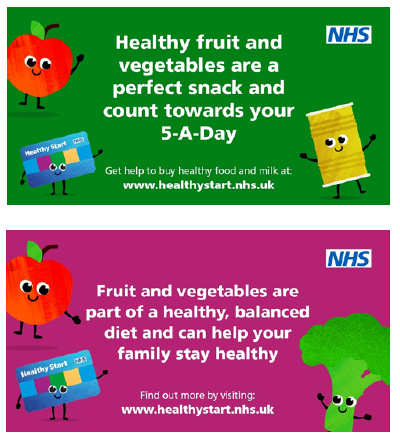
Healthy Start is a UK government scheme that supports low-income families and pregnant women through vouchers for fruit, vegetables, pulses, milk or infant formula.
To help families facing increased financial pressure, Sainsbury’s ran a trial between February and August 2021 in which customers received a £2 top-up voucher each time they used a government Healthy Start voucher in the supermarket.
At the time of the trial:
- Customers used paper-based Healthy Start vouchers
- Shoppers could use the £2 top-up voucher on future shops
- Sainsbury’s offered the top-up vouchers in supermakets only (not convenience stores or online)
- Shoppers could redeem the top-up voucher against fresh, canned and frozen fruit and vegetables.
What happened in this trial?
The Healthy Start top-up scheme ran for a 28 week period from 15th February to 31st August 2021. We analysed pseudonymised supermarket loyalty card transaction data from January 2019 to December 2021. The study included regular customers who redeemed one or more Healthy Start top-up vouchers during a trial period across four UK regions.
What did we find?
Over the 28-week period, 37,763 top-up vouchers were redeemed by eligible Sainbury’s customers across 878 stores. In the regular customer cohort across 4 regions, 1,363 Sainsbury’s customers used the scheme, making 4,212 shopping trips where the Healthy Start top-up voucher was redeemed. 98% of vouchers redeemed the full £2 on fruit and vegetables, as intended. Vouchers were mostly spent on fresh fruit and vegetables, rather than frozen, canned or dried fruit and vegetables.
When customers used a top-up voucher, their purchases shifted postively towards the Eatwell Guide with fewer discretionary purchases and more fruit and vegetable purchases.
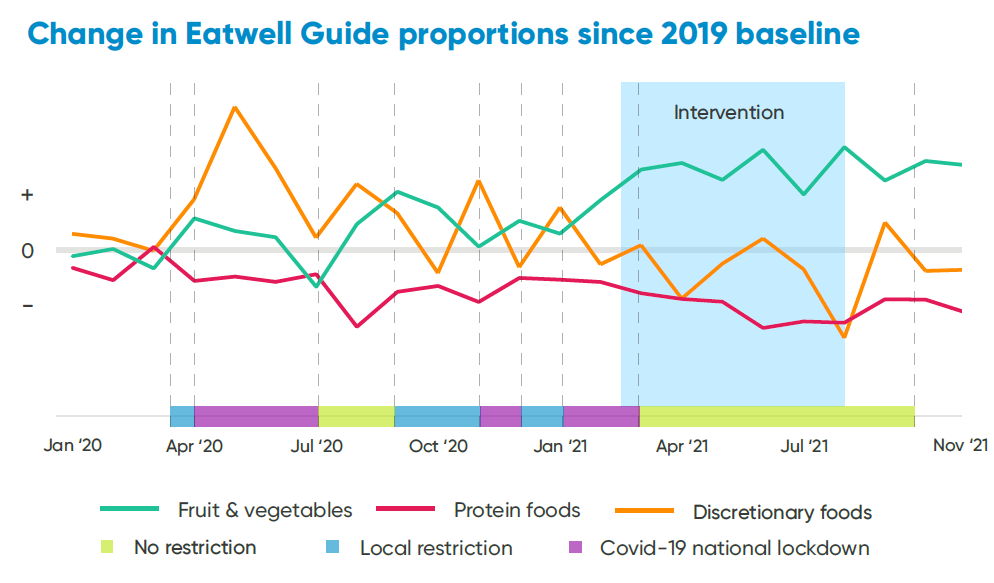
During the intervention period, there was a positive impact on the purchasing behaviours of customers who engaged with the scheme, even on the occassions they were not using a top-up voucher. Compared to baseline, these shoppers purchased more fruits and vegetables, fewer discretionary items and fewer protein-rich foods. A small but significant change in behaviour was measured for the three months after the trial ended.
Publications related to this research
If you would like to find out more about this research please do read the visit the links below.


